I guess we are all guilty of wanting things our way but how fast can you let go?
Copyright © 2018 Jorge Luis Carbajosa

Fishermen in Lomé, Togo
I guess we are all guilty of wanting things our way but how fast can you let go?
Copyright © 2018 Jorge Luis Carbajosa
Fishermen in Lomé, Togo

Avepozo beach, Lomé, Togo
This last October, I had the privilege of staying in Avepozo, a quartier, or neighborhood, of Lomé, Togo. In the Ewe language, which locally it is referred to as Mina, it means a thick forest area that has been burnt to make way to farmland. And one can see it is an area rich in agriculture and water.
Avepozo is also in the Eastern part of Lomé. It has a number of hotels and I was able to visit the Madiba hotel on the western part of this neighborhood. It is right on the beach and I found it to be quite pleasant. The food there was superb and it was very calm and not noisy at all.The rooms were very clean and the service very friendly. A few meters away from

Typical Fishing boat in Avepozo
the hotel’s beach, there are fishermen who bring fish twice a day and sell it to anyone, including to the hotel, who prepares and cooks the fresh fish for their clients. I understood the price of the fish to be very inexpensive. One red snapper that must have been about almost a 75cm long and 40 cm wide cost 30,000 CFA.
In the mornings I would walk from a private residence of some of my in-laws, north of the hotel Montaniato (sorry no website), which I did not have the chance to frequent, to the beach, so past the N2 main thoroughfare (listed on google maps). On my way to the beach, I would walk past a garage shop where cars are repaired and past some shantyhomes, sometimes down a narrow stretch of land of perhaps 200 meters long, where garbage is deposited by the local residents. It doesn’t appear that there is any garbage collection in this area of Lomé (I also didn’t see any garbage burning, which would have made for a lot of pollution). Although I often was scared to walk alone, or with my brother down this area, it was not dangerous at all, and I found residents to be very friendly, despite their clear lack of modern means. Most of the dwellings I saw, as I got closer to the beach, seemed to lack running water and electricity although I can’t say for sure. I did see many water wells all over the neigborhood, so I don’t think there is any shortage of water whatsoever. I also saw an abundance of food and street vendors. I only saw one child in Lomé, who was perhaps suffering from mal-nourishment. The child had a big belly, but because I saw the child at a distance, I couldn’t tell if the child was fat or suffered from kwashiorkor.

Fishermen and workers gathering and preparing fish Avepozo, Lomé, Togo, West Africa
The approximately 12 days I was in Lomé, in mid-October, it only rained one day for a couple of hours. All other days it was very hot, humid and sunny, with few clouds. Temperatures were in the thirties celsius and it was quite humid. I didn’t get a lot of mosquito bites, maybe about 4 or 5 total and I believe it was due to the fact that I was taking vitamin B every day. When I saw I was getting mosquito bites, I doubled my dose of vitamin B and I didn’t get any more. The ones I got, by the way, were rather insignificant, not the ones one would expect to get from tiger mosquitoes, although apparently the mosquitoes in this area of Lomé are small.
One thing that I found difficult in Lomé was the malaria medication I was taking. In my opinion this medication made me go to the bathroom a lot, up to 3 times a day, and my stools were very dark and liquidy. Other people taking the medication told me “yes, it does that.” I also got some food poisoning in Togo, so I was sick with diarrhea for two days, which I cured by only eating white rice, white bread, white crackers and an occasional soda. I lost about 15 pounds in Togo, and it might have something to do with the loss of water, although I kept myself well hydrated.
Although I had it when I was a child, I was told by my doctor’s in the U.S. that I would have to take it again. I decided to take it upon arrival at the Lomé airport. I paid 10,000 CFA for it and the whole process took about 20 minutes. I noticed the nurse did not wash his hands before putting his gloves on to administer the vaccine but he applied alcohol to my arm and the needle he used was sterile. I was given a small booklet and receipt as proof of vaccination.
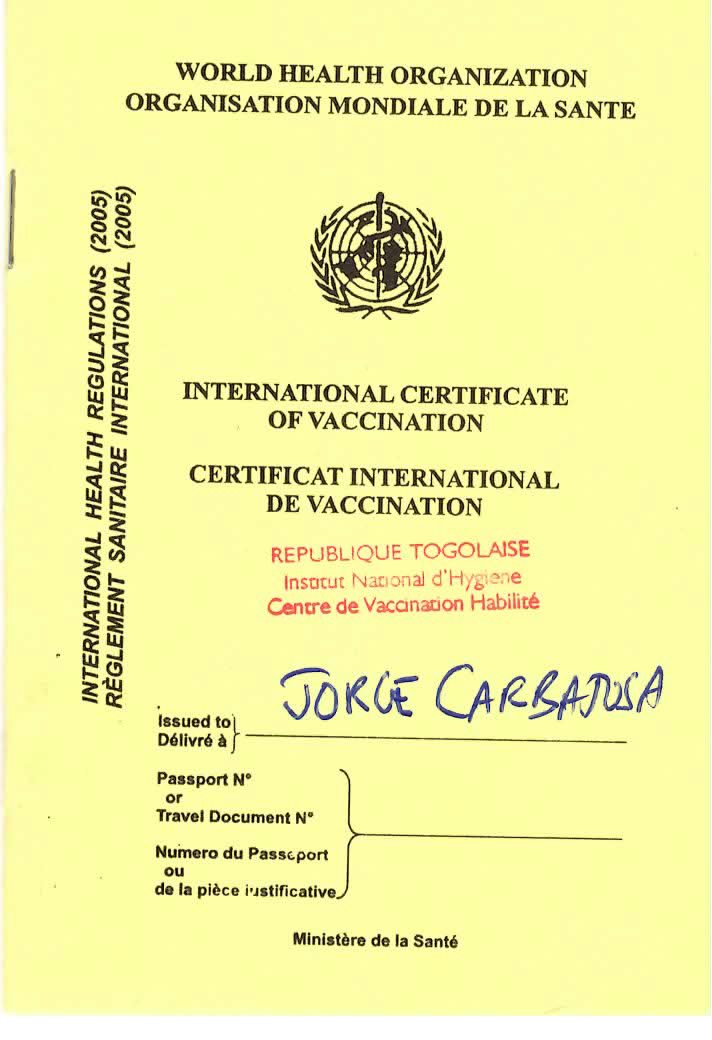
Vaccine Booklet
I got my visa to enter Togo at the airport of Lomé and I paid 10,000 CFA for it and it was good for 7 days. Getting the visa at the airport was not lengthy because the Tokoin International Aiport is a modern airport which does not handle a lot of traffic. To extend the visa, I went to a suburb called Agoé, which is not listed in Google as a separate town or suburb. Service de Passeports at Avenue de la Chance are listed, however, and that is where one can get a visa extension. My in-laws knew someone who works there so we were fortunate to not have to wait for too long. The line was not long but the paperwork is a little tedious. I have been told getting a visa in the U.S. through the Togolese embassy in Washington DC can cost more than $100.
During our stay in Avepozo, we witnessed 3 days of demonstrations, two consecutive days and one a couple of days later. During the manifestations were not able to leave the house because everyone said it was too dangerous. We saw tires burning on the main thoroughfare, the N2, about two blocks from the house we stayed in. If you have never seen a tire burning, it burns completely, creating a lot of smoke and it leaves soot in a large radius around it, up to at least two blocks away. It is unfortunate for the environment. I am sure that burnt tires have a high level of toxicity and that soot must have gotten all over the agricultural plots everywhere in Avepozo, and in children’s food. I saw one burnt car although I was told many were burnt.
Someone
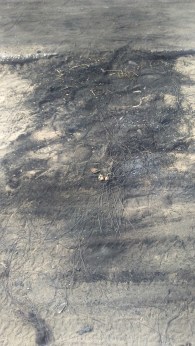
Burnt Tire Remains. Notice the metal wires.
we knew decided to go to the downtown area of Lomé in a vehicle during one of the days of civil unrest. He told us he had to bribe the police and demonstrators to reach his destination and return. He said he was quite frightened but had no problems when he paid what the soldiers and demonstrators dema
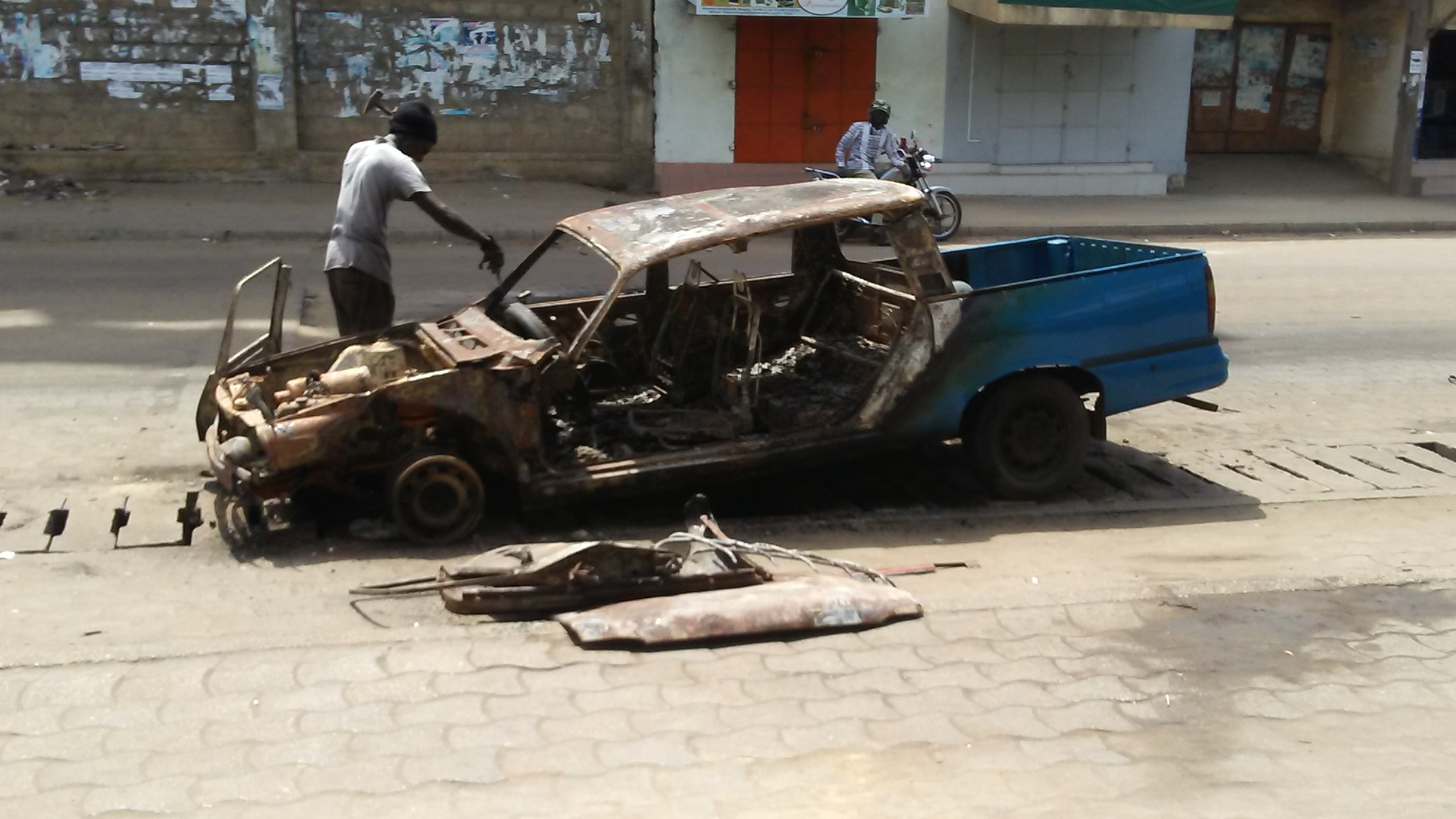
Civil unrest in Lomé, Togo
nded, which was not very substantial. He ended up transporting some demonstrators with him in his vehicle, as proof that he already had paid to get through one of the roadblocks and so that he wouldn’t have to pay again at the next one set up by the manifestants.
I saw on a French news report that up to 4 people had been killed by the police during the first two days of demonstrations. Natives, however, told me that it was a lot more and I was shown many pictures of dead people that had been posted on social media. I had no way of knowing if the pictures were real, which showed dozens of dead persons and some with mutilated bodies. One fellow who was Togolese but a resident of Germany assured me the pictures were real.

A typical dirt road in Lomé and Muslim woman walking
Because my wife is from Togo, I spent most of my time in Lomé visiting relatives, which meant being on the road 4 to 6 hours per day. We had two different chauffeurs drive us around. One chauffeur accepted to drive us and our host family, who are from Togo but live in the U.S, for 12 days for a total of $100, although he ended up getting paid about $125. I frequently spoke to this particular driver and one time I asked him how much money per month he would need to live a comfortable life. He said what came out to be $2
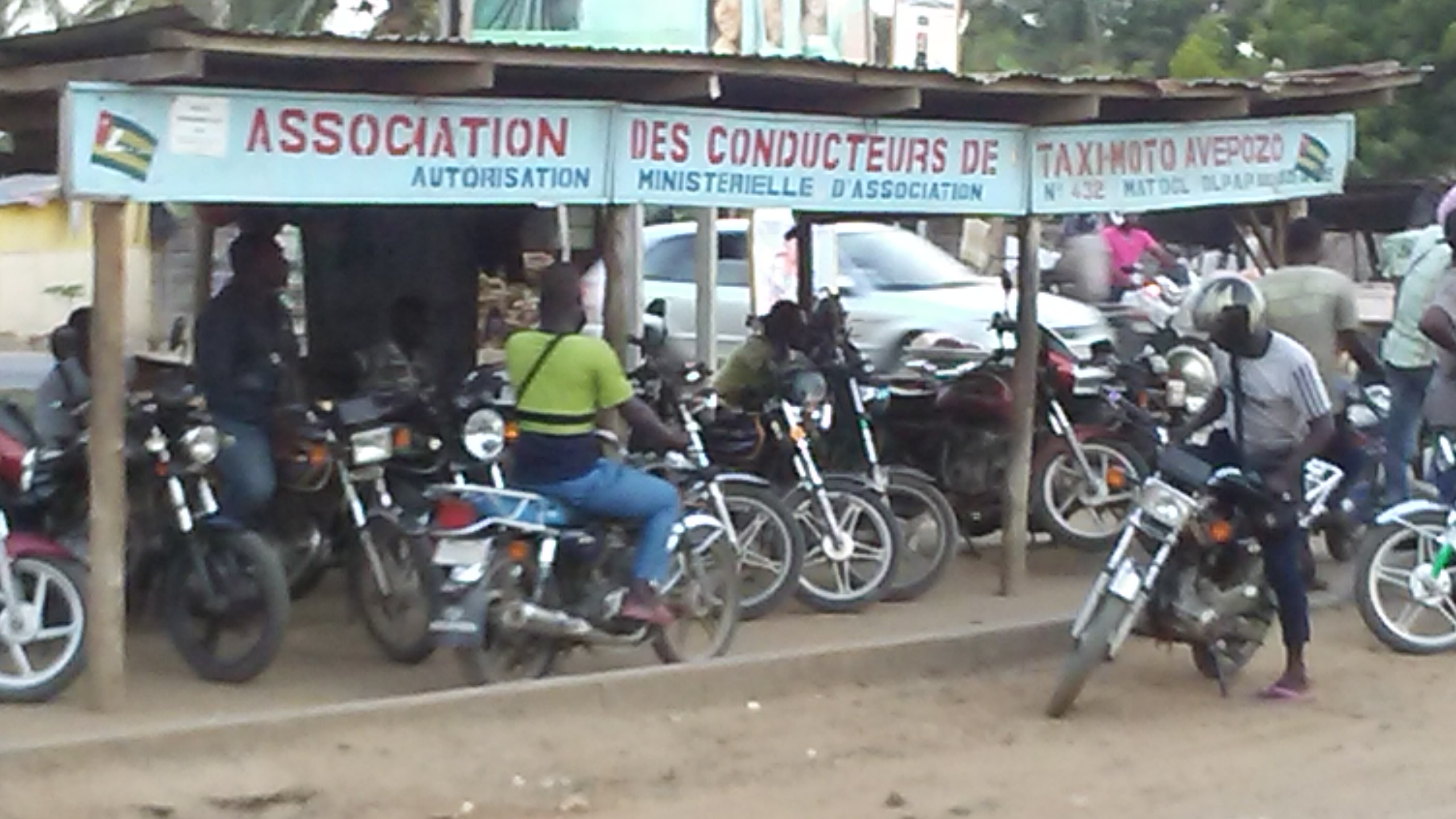
Mototaxi center at the N2 in Avepozo, Lomé, Togo
60 per month. I also found out the minimum wage is 35,000 CFA per month, or $61/month. The other driver was provided to us by an in-law. Most roads in Lomé are not paved but the main roads were good. There were a lot of motorbikes on the road, which I was told are made in China and are quite inexpensive, about $500 for a new motorbike. Many of the motorbikes are actually mototaxis and one can ride in the back. I paid 100 CFA one time to ride from our residence to the Madiba hotel, about 1 km or less. I saw three wheeled taxix that could transport about 4 people comfortably. I was told anyone could buy a new one for about $3000 and

Motorbike traffic in Lomé, Togo
start working right away.
If you are a US citizen and if you want to drive in Togo, get yourself an International Driver’s license before travelling. The fines for not having a proper driver’s license can be very high for Togolese standards, up to $50.
To exchange dollars and other currency,
one fellow would come over to my host family’s house and would give us an exchange rate of up to 580 CFA per $1 USD. Other times we needed money we went to the Grand Marché, in the Assigame neighborhood, and we would drive up to one bank and plenty of people outside the bank would offer to exchange dollars for us. I found it quite unsettling at first but it was perfectly safe and I witnessed no crime at all in Togo and I never saw anyone who even had the remote appearance of being a crook or criminal. In my experience in other countries one can tell right away who has bad intentions. In Europe no one would dream of exchanging money anywhere else but in bank or currency exchange.
Like in other African countries I have been to (Morrocco and Kenya), I witnessed a lot of haggling and aggressive sales at the Great Market (Grand Marché). In my opinion it is best not to have direct eye contact with anyone, nor accept anything, or touch anything at all, if you are just looking at things out of curiosity. I was fortunate that if I wanted

The Grand Marché in Lomé Togo, Assigame
something, my in-laws would buy it for me and go through the trouble of haggling for it and then I saw prices drop up to 60 to 70% from their original price. I did buy somethings myself, namely a pair of shoes and a belt, which I didn’t quite want. I paid 5000 CFA for the shoes and 3000 CFA for the belt, probably about 150% more than I would have, had I allowed my relatives to buy it for me. I had a mild interest in both products but the vendors had placed them in my hand and then it was almost impossible to say no. I found the Grand Marché has a wide range of products from luggage to Food.
Although the U.S. Deparment of State “has assessed Lomé as being a critical-threat location for crime directed at or affecting official U.S. government interests,” I found the neighborhood of Avepozo to be very safe and peaceful. For more information about Togo, you may also visit the United States Department of State Bureau of Diplomatic Security’s Togo 2017 Crime and Safety Report.
Copyright © 2017 Jorge Luis Carbajosa

The N2 Road in Avepozo, Lomé, Togo
En primer lugar, quiero decir que soy partidario, partidaria de la igualdad o igualdado de sexos y sexas, cosa o coso que debe reflejarse en la lengua española o en el lenguo español .
Así pues, unas breves y brevas palabros y palabras. Queridos y queridas miembros y miembras de la familia y familio Carbajosa y Carbajoso, Carballo y Carballa, estamos de enhorabuena y enhorabueno por la boda y bodo de Mercedes y Victor o de Victor y Mercedes que tanto importa, importo tanta.
Quiero felicitar a Mercedes por entrar en el club o cluba de los maridos y maridas y a Victor por entrar en el círculo o círcula de los cónyuges o cónyugas. Y como aquí hay ropa y ropo tendida o tendido, termino esta coña marinera o coño marinero pidiéndoos que levantéis una copa o copo por la felicidad o felicidado de Mercedes y Víctor.
Copyright © 2017 Jorge Luis Carbajosa
This last October twenty-first, I was in Lomé, Togo and I met two Dutch men who are currently on a motorbike trip from Holland to South Africa and this is their website: http://africa-over.land/
Here’s a picture of these two fellows, father and son:
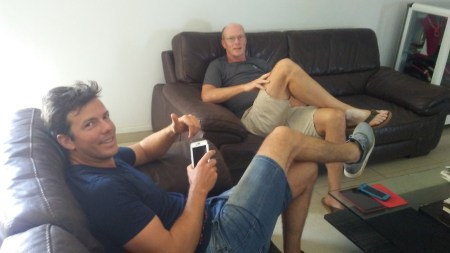
Dr. Johan and his son, Wilbrink, in Lomé, Togo, on 21-10-2017 at the Madiba Hotel
And here is a picture of one of their motorbikes:

Dr. Johan, a Medical Doctor in the Netherlands, mentioned he was taking 3 months off from work to do this Road Trip and that the BMW motorbikes they are using are equipped with cameras that take pictures every 30 seconds that they are on the road.
He added they were probably going to ship their bikes from Cotonou, Benin, to somewhere south of Cameroon, since they would not be able to enter Cameroon due to civil unrest in that country.
Their website has all the details about their trip and mentions Lomé here.
It was nice to meet these two men and I wished Dr. Johan the best of luck.
The Madiba Hotel in Lomé, where I met Dr. Johan and Wilbrink, is in the Avepozo neighborhood.
I later learnt there is a website http://africa-overland.net/ portal for people who travel Africa over land, perhaps these two men were inspired by this portal and named their website similarly.
Copyright © 2017 Jorge Luis Carbajosa

My son Kemen, less than 30 minutes after birth
I was dormant for many billions of years and now I find myself awake. It is hard to move after being asleep for so long. This sensation of awakeness is rare but true. I am a new me.
Copyright © 2017 Jorge Luis Carbajosa
Thousands of years ago humans never greeted each other. People just went to work and never said hello, good morning, good afternoon, good evening and even bye. Life was the same; nothing was different. People just didn’t greet each other. There was no need. Then one day one fellow who was rather upset at work, but for no reason, decided to say good morning to his fellow employee, just to blow off some steam.

Photo by fauxels on Pexels.com
“Good morning.”
“Is it really? Why do you say that?” His fellow employee replied.
After a long thought the inventor of greetings sighed and said, “Look, I just want you to say good morning back to me.”
His fellow employee thought about it for a second.
“OK, no problem. Good morning.” And then he thought to himself: I prefer not to have an argument. I just want to have a good day at work today and go back to my family this evening. Couldn’t care less what this moron wants. It don’t make any difference. I’m not going to argue and create a problem for myself.
And so it became a habit in that office building a couple of milleniums ago. Now these two persons would just say good morning to each other every day and soon the secretary started doing the same thing because she thought it was cool and all the other co-workers thought so too. Even the supervisor liked it. Then one day somebody came up with the idea of saying good-bye in that same office building and it caught on too. Then it started happening on social media, text messages and soon after the whole world started doing it. Some people think the first text message with a greeting was in Japan somewhere but no one knows for sure. In any event, it is so common now that no one gives it much thought.
Copyright © 2016 Jorge Luis Carbajosa
I went to a transmission shop to inquire about my car. The man who helped me had a strong accent and looked like he was from the southern Mediterranean or from the
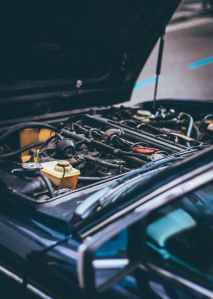
Photo by George Sultan on Pexels.com
Middle East. I saw the name on his tag “Stan.” It was unlikely he was Spanish with that name. Normally, for a better communication, I like to speak to Spanish speakers in their native tongue, but this man did not seem to be Spanish speaking. He led me to his office and asked me to sit down. Then he sat on his big desk and took out two binders from a shelf.
“You said a Toyota?”
“Yes, a Solara, 2004, V6, 3.3 liter.”
He was looking through the charts, going back and forth in the pages.
After about a minute of looking at the tables, when I was beginning to think he wouldn’t have my car listed on his binders, he said:
“Front wheel drive?”
“Yes.”
“OK, the base price is $2300.”
“How long?”
“About 3 or 4 days.”
Then he explained to me all the details of how the job might cost more if they had to place a new or rebuilt transmission.
I was simply inquiring, not really having any intentions of fixing my car, but just selling it or giving it to my mechanic to see what he can give me for it. In any event, I got Stan’s business card and told him I would think about it.
When I was leaving, I asked him, “Where are you from?” and he said “Polish, Polski.” I told him I was from Spain so we could feel more connected, since we are both European. Then he said, “You look Polish.” and out of my mouth, I immediately answered back “And you Spanish.”


I let out some laughter as I was walking out. Just one of those funny moments in life, I thought to myself.
Copyright © 2016 Jorge Luis Carbajosa
En un grupo de Whatsapp, de compañeros ex-universitarios de una universidad estadounidense, ya todos cuarentones y en diferentes lugares de América y España, después de ver un vídeo de cómo una persona, al salir de Venezuela por la frontera con Colombia, insulta a un soldado venezolano, criticando el régimen militar chavista, hago la siguiente reflexión:
Yo: Así era también con Franco. Cuando la gente salía de España la gente cantaba de alegría, y si tenían que volver, volvían encabronados.
Cuando murió mi abuelo en Madrid en el 67, mis padres vivían en NY. Mi padre fue a Madrid al entierro. Mis tíos me han contado varias veces que cuando llegó mi padre, lo primero que dijo al ver su progenitor sin vida fue “qué hayas muerto tú antes que Franco ”
Y uno de mis compañeros andaluces, de los que mi padre llamaba “señoritos” me contesta:
Jorge. Esa es tu opinion y la respeto. Pero hay muchos españoles que no opinamos lo mismo. Y eso que a mi no me gustan las dictaduras de ningun signo-
Y no sé de donde sacas tu la similitud de la España de Franco con la de Venezuela de Maduro.
Si hubo con Franco algo fue seguridad y orden. Y como dice un refrán español” Lo que se puede demostrar no se discute”.
Y te vuelvo a repetir que no soy partidario de dictaduras. Pero hay que ser objetivos.
Y quillo olvidate de Franco que murio hace 30 años
Yo: Tienes razón. No se puede comparar la España de Franco con Venezuela. Franco mató y desapareció a decenas de miles o cientos de miles. Torturó a miles, y encarceló a miles y miles, incluyendo a mi abuelo, al que cuando le dejaron salir de la cárcel, no le permitieron trabajar durante 12 años, por rojo, y no lo era. ¡No me jodas!
Jorge tambien los republicanos mataron a mi abuelo en Puente Genil y mataron a muchos españoles. A muchos abuelos y padres de amigos míos. A miles.
Yo: OK y ¿cómo eso justifica a Franco?
Eso fue una guerra civil entre españoles. Y no me jodas tú.
Yo: Lo que he dicho es cierto. La gente se iba de España, cantando de alegría. No es una opinión. Mucha gente odiaba a Franco. Y todavía lo odian. Y España para ellos, era una mierda. Y es la verdad. Y los rojos matarían a muchos, pero no quita que Franco fue un cerdo sanguinario, violador de los derechos humanos, y asesino. Y para muchos España sigue siendo una mierda. Vete a Barcelona con la bandera española, o al País Vasco, y ponte hablar de Franco y de mi “opinión”. A ver qué te dicen. Y es la verdad.Y nunca he dicho que los rojos fueran santos.
Esa es tu opinión, que yo respeto, pero que no comparto en absoluto, y espero que tambien la respetes. Por que creo que tu crees en la libertad de expresión y opinión ¿no?
Y por cierto te mandare el vídeo del recibimiento a Franco en Bilbao en el 50. Y también en Barcelona. A lo mejor te sorprende.
Yo: A sí, pues adelante, ponle una banderas facha a tu moto, y date un paseíto por Bilbao. Ya me contarás. Y si sales vivo pásate por Barcelona.
Y no es una opinión. La gente, cientos de miles, se dice millones, se fueron de España, porque odiaban a Franco. Es cierto. Es la verdad. Está muy bien documentado.
Perdona, la bandera española , que tú le llamas facha, es la que aprobaron en 1975 todos los partido politicos incluyendo el Partido comunista cuando se redactó la constitucion. Y negar esa bandera es negarse a si mismo.
Y un consejo de amigo que te aprecia Jorge. Debes de dejar el resentimiento y odio que desprendes por que sino no vas a descansar nunca macho. Y la vida es muy corta para estar tan resentido
Y yo no se tú. Pero esa es mi bandera mientras así lo determine la constitución que todos los españoles aprobamos.
Yo: Pues no es a lo que me refiero pero sea como sea, las banderas de España no son bien recibidas en esas zonas.
Y me voy a dormir que too late.
Yo: Ok yo sólo he expresado verdades. Mi opinión aparte.
Bueno digamos que tu has expresados TUS verdades y yo las mias.
Yo: No compa. No son mis verdades. Sleep on it my friend.
Y después me pongo a pensar que con gente así en España, gente que no quiere reconocer el pasado, no me sorprende que haya tantos independentistas. Quién quiere vivir en esa España del pasado, de la mentira e ignorancia.
Copyright © 2016 Jorge Luis Carbajosa

Copyright © 2016 Jorge Luis Carbajosa
On January 28th, 2016 during the Republican presidential debate in Iowa, senator Marco Rubio (Fla.) said that Bernie Sanders is a “socialist” and a “good candidate for president of Sweden. We don’t want to be Sweden, we want to be the United States of America.” You can see the video here (00:38).
I would like to make a brief but accurate comparison of the U.S. versus Sweden, for those of you who have never been there and/or know little about democratic socialism and this Scandinavian country.
To begin with, the Sweden in its Better Life Index as the second country in the world versus seventh for the U.S. This Index compares well-being across countries on 11 topics that it has “identified as essential, in the areas of material living conditions and quality of life.”
Here are some other general considerations:
According to Transparency International, Sweden is the third least corrupt country in the world, and the U.S. ranks number sixteen in the world. Politicians in Sweden are also not as rich as our politicians here and many people argue that Sweden is more democratic than the U.S. with a much higher voter participation, which according to the Pew Research Center it was 85.8% in 2014 of registered voters, and as low as 53.6% in the U.S. In addition, some experts don’t even consider the U.S. to be a democracy anymore, but rather, a corporate welfare oligarchy.
Unemployment in the U.S. is lower than in Sweden but not by much. In the U.S. it is currently at about 4.9% and in Sweden at about 6.7%. You might think that we really beat Sweden but what does it mean to be employed in Sweden versus in the U.S?
In Sweden all workers enjoy a full 5 week paid vacation beginning in their first year of employment, with 16 additional paid public holidays. In the U.S. according to the Bureau of Labor Statistics, the average paid holiday per year in small private companies is 7.6 days for full-time employees.
Maternity leave for all workers in Sweden is 480 days, of which 90 days are reserved for men. During that time, workers get paid 80% of their wages. A Swedish worker can take this leave until the child turns eight years old. It can be taken in weeks, days, half-days and even by hours. The government there also gives you a monthly allowance for every child you have up until age 16. Swedish companies are also very flexible with their employees, who get up to 80% of their pay when they have to stay home due to illness of their children or dependents. Swedish employees enjoy up to 120 days of this type of additional parental leave per child.
Sure, according to the OECD, the U.S. ranks number 1 in income, Sweden number 8; number 1 in Household Financial Wealth, Sweden number 9; number 1 in Household net Adjusted Disposable Income, and Sweden number 9.
However, in 2012 the OECD ranked the U.S. to be number 3 in the highest poverty rate and Sweden number 20; it also ranked Sweden as number nine in lowest income inequality and the U.S. as number 29. This website reports Sweden to have lower real estate, rent and consumer prices, another website reports Sweden to have an overall higher cost of living.
Sweden scores number six in the OECD’s work-life index, and the U.S. number 29.
Swedes believe that all their citizens should have equal access to health care. They have one of the best health care systems in the world and their average life span is 80.1 for men, slightly higher than in the U.S which is at 78 for men. Health and dental care are completely free for all Swedes up to age 20 and there is a limit on individual contributions to healthcare of 900 Swedish Kronor per year (about $107.22) for the rest of the population, meaning that once an individual has reached this limit, all other healthcare services and medical consultations for the remainder of the 12-month period are free of charge. Private health care is also available for Swedes, although it is reported to be uncommon due to the high quality of its universal state healthcare system.
Infant mortality in the U.S. is almost twice of Sweden being at 5.97 per live 1000 births versus 2.8 in Sweden in 2015.
In 2015 Sweden was ranked to be number 4 of the world’s most equal countries for men and women, behind Iceland, Norway and Finland, all Scandinavian countries. The U.S. came 28th. Sweden is ranked number 5 in the world for the number of women in parliament with 45% of women representation at the national level. The same report ranks the U.S. as number 75 for the number of women in parliament. Representation of women in the U.S. congress is 19%.
Like the U.S. Sweden is also a world leader in higher education. The biggest difference, however, is that college and university in Sweden are free. In 2005, Sweden ranked 6th in the world with the top 200 universities per million and the U.S. number 17. Univesitas 21, has consistently placed the U.S. as the world’s best country for higher education but in 2012 it ranked Sweden as the world’s second and in 2015, as number 6. Swedes are also encouraged to go back to college and/or university for a second degree, with free tuition, subsidized child-care, and low cost loans for living expenses. Employers have to hold their jobs when they enroll full-time, albeit without income.
Like other Scandinavian countries, Sweden is one of the safest countries in the world. The murder rate in the U.S. is 143 times higher than in Sweden. Homicides in Sweden are 0.7 per 100,000 and 4.7 per 100,000 in the U.S. General crime levels are ten times higher in the U.S. than in Sweden. Incarceration levels are less than 70 per 100,000 in Sweden and in the U.S. they are over 500 per 100,000, the highest in the world. Unlike in the U.S. Police crimes and brutality are not common, and mass shootings in Sweden are almost unheard of. It is true that rape is twice as high in Sweden but many people say it is because the definition of rape is wider. In addition, conditions in Sweden are such that women are encouraged to report any and all kinds of sexual assault and are not shamed for doing so. Some experts report that a higher gender equality may be a factor too. In the U.S. according to some accounts as many as 68% sexual assaults are not reported to the police.
Terrorism in Sweden is rare. There have been 4 terrorism related deaths since 1975.
Sweden is a world leader in garbage management and recycling. Currently only 1% of their garbage ends up in landfills. In the U.S. as much as 55% of our waste ends up in landfills and our recycling rate in 2012 was 34.5%. Sweden’s recycling rate is currently 99%. In Sweden people separate their garbage at home or in the building they live in and have recycling centers less than 600 yards from any residential area. Swedes produce about 460 kg of garbage every year per person and Americans 730 kg per person.
In 2012 the World Cancer Research Fund International ranked the U.S. to have the sixth highest cancer rate for men and women in the world, and Sweden was ranked twenty-fourth. In the U.S. the amount of debris inhaled per person per year is almost twice of Sweden.
Sweden is also a more consumer friendly nation than the U.S. Being a member of the European Union they follow “credible evidence principles” to implement “protective action despite continuing scientific uncertainty.” In the U.S. however, we use the principle that harm must be proved before “regulatory action is taken.” For instance Swedes are wary of GMOs and have very large GMO free zones throughout their country. In the U.S. foods are not even labeled as GMOs. Another example is the case of food dyes such as a Red Dye No. 40, Yellow Dye No. 5 and Yellow Dye No. 6, which are suspected to cause hyperactivity in children, and are banned in Sweden but not the U.S.
Unlike the U.S. Sweden is a champion of human rights. In fact Sweden is reportedly the first country in the world to introduce freedom of press in 1766, 10 years before the U.S. was founded. The death penalty, which is considered by Amnesty International as “the ultimate, irreversible denial of human rights” ceased in Sweden in 1921 and was officially abolished by its constitution in 1975. The U.S. executed 27 persons in 2015.
Human Rights Watch world report of 2015 states that the U.S. “in the areas of criminal justice, immigration, and national security, US laws and practices routinely violate rights.” Its report on the U.S. is quite lengthy and thorough and in contrast, it does not have any report on Sweden because human rights violations there are not an issue. Regarding refugees, Sweden throughout history has been a leader in opening its borders to refugees. It remained neutral in the second world war and does not belong to NATO. It did not participate in the Iraq War. In 2003, Sweden’s prime minister stated “Sweden views a military attack on Iraq without the support of the UN Security Council as a breach of human rights.” Unlike the U.S. Sweden is a peaceful nation.
Perhaps being like Sweden is a good thing.
Copyright © 2016 Jorge Luis Carbajosa
Sources:
http://www.businessinsider.com/major-study-finds-that-the-us-is-an-oligarchy-2014-4
http://data.bls.gov/timeseries/LNS14000000
http://www.tradingeconomics.com/sweden/unemployment-rate
Girokonto oder Kreditkarte? Die Finanzprodukte im Vergleich
http://www.nationmaster.com/country-info/compare/Sweden/United-States/Government
http://www.oecdbetterlifeindex.org/topics/work-life-balance/
https://data.oecd.org/inequality/poverty-rate.htm
http://www.pewresearch.org/fact-tank/2015/05/06/u-s-voter-turnout-trails-most-developed-countries/
https://sweden.se/society/10-things-that-make-sweden-family-friendly/
http://uk.practicallaw.com/1-503-3778?q=%22Joint#a632877
https://en.wikipedia.org/wiki/List_of_statutory_minimum_employment_leave_by_country
http://link.springer.com/chapter/10.1007/978-1-349-13188-4_12
https://sweden.se/society/health-care-in-sweden/
http://www.prb.org/Publications/Articles/2012/us-incarceration.aspx
http://www.rccmsc.org/resources/get-the-facts.aspx
https://en.wikipedia.org/wiki/Rape_in_Sweden#Unreported_cases
https://sweden.se/society/gender-equality-in-sweden/
http://www.usatoday.com/story/money/2015/11/19/us-falls-28th-global-gender-equality-list/76018174/
https://sweden.se/society/gender-equality-in-sweden/
http://www.ipu.org/wmn-e/classif.htm
https://sweden.se/society/higher-education-and-research/
http://www.nationmaster.com/country-info/compare/Sweden/United-States/Education
http://country-facts.findthedata.com/compare/1-178/United-States-vs-Sweden
https://www.justlanded.com/english/Sweden/Sweden-Guide/Health/Health-Insurance
http://www.huppi.com/kangaroo/L-pollutioncomparisons.htm
http://www.wcrf.org/int/cancer-facts-figures/data-cancer-frequency-country
https://sweden.se/nature/the-swedish-recycling-revolution/
https://center.sustainability.duke.edu/resources/green-facts-consumers/how-much-do-we-waste-daily
Banned in Europe, safe in the U.S.
https://sweden.se/society/sweden-and-human-rights/
http://www.thelocal.se/20120903/42972
http://www.amnestyusa.org/our-work/issues/death-penalty
https://en.wikipedia.org/wiki/List_of_countries_by_infant_mortality_rate#UN_Sweden
Thank you Mother Earth, Sun, Great Spirit, Higher Power, what some people refer to as God, thank you for the life you have given us.
Please help us abolish all borders and live together as the true brothers and sisters that we are, in a respectful and considerate manner towards not just our fellow humans, but to other beings on this planet, such as Plants and Animals.
Please help us live in tolerance and respect, with transparent governments and without fear.
Please help us live in a way where we protect our environment for us and for our children.
And thank you Higher Power, once again, for the opportunity to live.
Copyright © 2016 Jorge Luis Carbajosa
 El descampado